


| Stay Connected | Quick Links | ||||||||||||||||||
 |
 |
 |
 |
 |
Derivan HealtheClean |
 |
Derivan Anticrib |
 |
Colour Charts |
 |
SDS |  |
Images |  |
 |
Derivan Apps Downloads |
|||

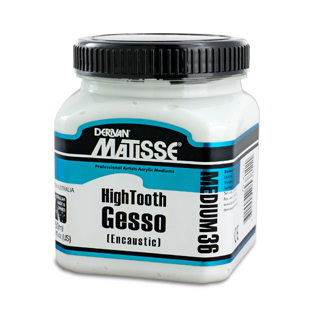
MM36 High Tooth Gesso (Encaustic)
See also MM10 Artist Gesso | MM25 Black Gesso | MM27 Low-Viscosity Gesso
Permanent, flexible water-based ground, with a high tooth finish, for canvas, board, wood panels or paper. High Tooth Gesso dries to a bright white, matte surface that provides much more "bite" and absorbency than a standard gesso, making it a recommended ground for encaustic work or as a soft and oil pastel primer.
 Available in 250ml and 1 Litre sizes.

While it is possible to make your own encaustic gesso, to prepare your substrate, it can also be a time consuming, messy and expensive process. Homemade encaustic gesso must also be used within a few days as it susceptible to mould growth.
In response to this problem, Matisse has created MM36 High Tooth Gesso (Encaustic). This unique product provides an easy alternative to creating a surface for encaustic painting. Used straight from the container, High Tooth Gesso dries to a white, matte surface that provides much more “bite” than standard gessoes. More importantly, it is water-based and contains no acrylic resins that would make the surface too smooth and refined for the application of wax. Although pre-treated encaustic painting boards are available, using Matisse High Tooth Gesso allows the artist to customize the surface sizing of their project and is also more economical.
The techniques and methods of encaustic painting are many, and the use of Matisse High Tooth Gesso caters for them all and ensures that your artwork will remain stable for as long as possible.

Application
Matisse MM36 High Tooth Gesso is best applied with either a flat brush or roller. A minimum of two coats is recommended to ensure complete coverage.
Drying Time
Subject to atmospheric conditions, allow 1 to 2 hours drying time between coats.
Finish
Matte, bright white with a high-tooth surface. As a comparison, this product has much more tooth than either the Matisse white and black gessoes. It forms a gritty, dry surface.
Clean Up
Clean brushes, paint rollers and hands with warm soapy water.
Encaustic and Substrate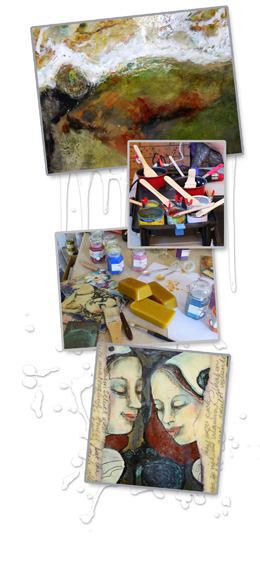
Encaustic painting, also known as “hot wax painting”, refers to the process of mixing melted wax with pigment to create a soft, coloured paint-like blend that can be manipulated with implements and heated metal tools. As most other painting techniques, Encaustic work requires a properly prepared surface to allow the painted layers to adhere successfully to its support.
The wax, mostly beeswax (this type is preferable as Paraffin wax can be britle when it sets), is heated until it is clear using the double-boiler method (where one small saucepan is placed in another saucepan of water on a stove) or with specialist warming appliances made specifically for this purpose. Pigment is then added. This is in general terms a simple description of an encaustic mixture, but there are several recipies available that may include the addiiton of damar resin, linseed oil or the use of other waxes. Nowadays, there are commercialy pre-blended wax and pigment blocks that only need to be melted before application.
The wax and pigment blend must be kept warm during application, and this is typically done with a warming tray. Although it can be a labour-intensive process, artists who use the encaustic painting technique frequently refer to its texture and luminosity, unique qualities that cannot be mimicked with either acrylic or oil paints.
Both oil and acrylic paints can be applied over acrylic based gessoes (there are also specialist linseed oil based gessos, which are specifically formulated to be used in oil panting techniques. These are definitelly not suitable ground for acrylic painting).
However, the encaustic artist faces a unique problem in that typical acrylic gessos do not work particularly well with the wax and pigment blend as surface partially repels the wax.
While it is possible to make your own encaustic gesso, it can also be a time consuming, messy and expensive process. A bag of rabbit skin glue crystals need to be soaked overnight, before being added to a whiting/pigment blend and boiled. Once cool, the mixture needs to be strained to ensure that the dried surface will have a smooth tooth. Homemade encaustic gesso must also be used within a few days as it susceptible to mould growth.
A strong tooth is important to the encaustic painter for three main reasons. Firstly, it absorbs the wax adhering it to the surface. Secondly, it also allows the artists to use coloured wax/pigment blocks to “draw” an underpainting on the surface before applying clear melted wax and blending. Thirdly, the surface also makes it possible to apply charcoal, watercolour or both oil and dry pastels before the applying the melted wax/pigment blend.
The techniques and methods for using encaustic are many, and the use of Matisse MM36 High Tooth Gesso caters for them all and ensures that your artwork will remain stable for as long as possible.
Encaustic painting is also frequently done on wooden surfaces and Matisse High Tooth Gesso dries quickly ensuring the wood does not absorb a substantial portion of the gesso. Traditional methods for making encaustic gessos wich include the use of rabbit skin glue size may require multiple applications to offset the absorbent nature of some timbers.
